
Custom Vinyl Lettering & Logos That Tell Your Story
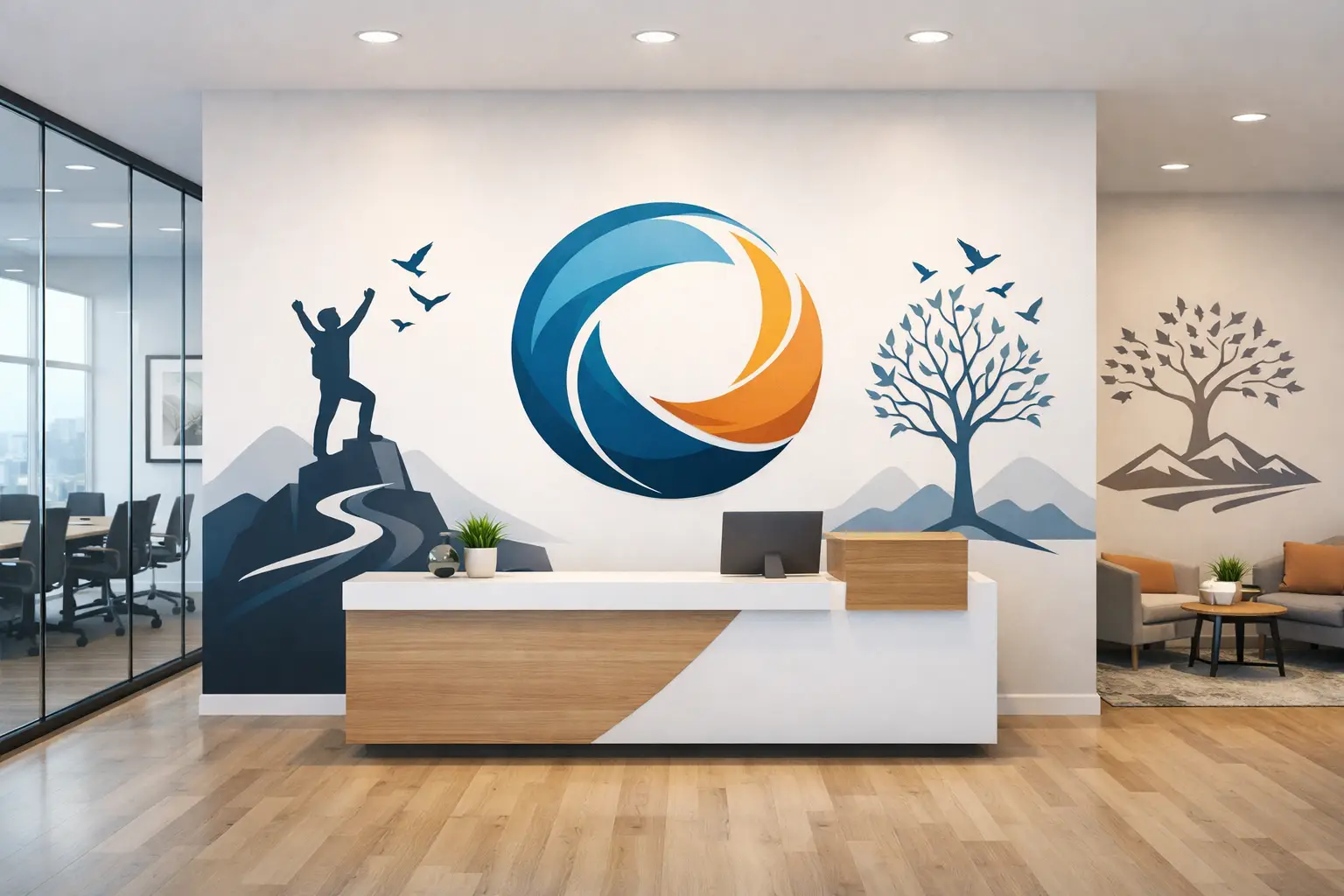
A blank lobby wall can leave visitors wondering who you are and what you stand for. Custom vinyl lettering & logos give that first impression a voice. Whether you are welcoming families into a church, recognizing donors at a nonprofit, calming patients in a wellness office, or building pride in a small business, thoughtful graphics help people understand your story before a conversation even begins.
The best wall and glass graphics are not decoration added at the end of a project. They are part of the environment itself: clear, intentional reminders of the values, care, and purpose behind the work happening in that space.
What Custom Vinyl Lettering & Logos Can Communicate
Vinyl lettering is a clean, versatile way to place words directly on painted walls, doors, windows, reception desks, and other smooth surfaces. It can be as simple as a short welcome message or as detailed as a full mission statement in carefully chosen fonts and colors. Paired with a custom logo, it turns everyday surfaces into meaningful touchpoints.
For a church, that might mean a scripture placed at the entrance, a statement of beliefs in a gathering area, or a children’s ministry wall that feels warm and inviting. A nonprofit may use lettering and logos to show its mission, highlight community impact, or create a donor recognition display that honors generosity with care.
Schools can reinforce their values in hallways and staff spaces, while medical, dental, and wellness offices can use calm messaging and branded graphics to help patients feel reassured from the moment they arrive. For small businesses, a logo wall and clearly displayed core values can make a workplace feel more established, united, and distinctly yours.
The message does not need to be lengthy to be powerful. A few well-chosen words, placed where people naturally pause, can shape how they experience a space.
Start With the Moment You Want to Create
Before choosing a font or color, consider what someone should feel when they enter the room. Should they feel welcomed, encouraged, informed, valued, or energized? That answer gives the design direction.
A reception area often benefits from a logo and concise mission statement because it quickly answers, “Who are you, and why are you here?” A team room may call for core values that keep daily decisions connected to a shared standard. A quiet hallway or counseling space may be better suited to an uplifting quote or simple phrase that creates room to breathe.
Think about the audience as well. Visitors need orientation and reassurance. Staff and volunteers may need reminders of the mission they carry every day. Donors and community partners should be able to see the impact and identity of the organization they support. One wall does not need to say everything, but it should say something true and useful.
Choose words people can absorb quickly
Walls are not brochures. Long copy can work for a donor wall or a detailed history display, but most lettering is strongest when it is easy to read in a few seconds. Use a clear headline, a short mission statement, or a focused value statement rather than trying to fit every detail into one design.
If a longer statement matters, give it enough open space and use a layout that guides the eye naturally. A professional design team can help shape the hierarchy so the most important words carry the visual weight.
Design Details That Make a Lasting Difference
Custom does not simply mean adding a name. It means making deliberate choices that reflect the character of your organization and work in the actual space.
Size and placement come first
The most beautiful lettering can lose its impact if it is too small for the wall or installed where people cannot comfortably see it. Measure the available area, then think about viewing distance. A phrase seen from across a lobby needs larger lettering than a message read while standing near a doorway.
Placement also affects meaning. A logo behind a reception desk feels official and welcoming. Values near a staff entrance create an internal culture moment. A message on glass can greet people before they even enter, while a feature wall offers a more immersive focal point.
Leave room around the graphic. Open wall space is not wasted space. It helps the design feel intentional and lets the words stand out without competing with furniture, signage, or artwork.
Fonts should match the message
A modern sans serif font can feel clean and confident for a healthcare office or professional workplace. A more expressive script may bring warmth to a boutique, children’s area, or inspirational quote. For mission statements and core values, readability should lead the decision. Decorative fonts are best used sparingly, usually for a few words rather than an entire paragraph.
If your organization already has brand fonts, using them can create consistency across print materials, digital communication, and interior spaces. If you do not have established brand standards, that is okay. Start with the feeling and purpose of the message, then choose a style that supports it.
Color needs contrast, not just brand alignment
Using brand colors is a natural choice, but the wall color, lighting, and surface all matter. Dark lettering often reads well on light walls, while light lettering can create strong impact on darker surfaces. A low-contrast design may look subtle in a mockup yet become difficult to read in a real room.
This is where samples and design previews are especially helpful. Looking at colors next to the actual wall can prevent a decision that feels right on a screen but disappears once installed.
Vinyl Lettering, Printed Graphics, or Both?
Vinyl lettering is ideal for crisp words, simple logos, individual names, scripture, and single-color designs. Because each letter is cut from quality vinyl, the finished look is polished and painted-on in appearance. It is a popular choice for mission statements, office values, window hours, and directional messaging.
Custom printed graphics are often a better fit when a design includes multiple colors, gradients, photographs, detailed illustrations, or a logo with fine visual elements. A full-color logo may need printed vinyl to preserve the details that make it recognizable.
Many spaces benefit from both. For example, a nonprofit lobby might feature a printed logo mark with cut vinyl lettering beneath it. A school could use printed mascot graphics alongside individual vinyl words that identify values or learning areas. The right option depends on the artwork, surface, budget, and visual effect you want to create.
Make Installation Feel Manageable
For busy leaders, office managers, and administrators, a wall graphic project can feel like one more item on a long list. Good planning keeps it simple.
Start by sharing a photo and measurements of the installation area. This helps identify surface challenges, such as textured walls, window frames, outlets, trim, or nearby furniture. Smooth, clean, dry surfaces are generally the best fit for vinyl, while heavily textured walls may require a different approach or additional testing.
Once the design is approved, installation guidance matters. Transfer tape keeps cut lettering aligned during application, and careful preparation helps the adhesive perform properly. Large designs may arrive in sections to make handling easier. Taking your time with alignment is worthwhile, especially for a statement wall that will be seen every day.
If you are unsure about sizing, materials, or installation, ask early. At Wall Words, in-house design support and responsive guidance help turn an initial idea into a graphic that is ready for its real-world setting, not just a digital proof.
Give Your Space a Message Worth Remembering
Custom vinyl lettering and logos work best when they are grounded in a real purpose. They can welcome a newcomer, steady a team, celebrate generosity, clarify a mission, or make an ordinary room feel more connected to the people it serves.
Your wall does not have to be loud to be meaningful. Give it words that reflect what matters most, place them where people can truly see them, and let the space keep telling your story long after the meeting, appointment, class, or conversation is over.